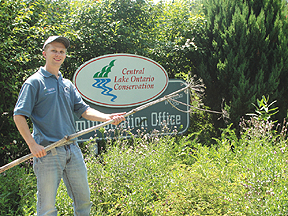
Dan Beare, an invasive species technician, shows off a dried out Giant Hogweed which was found in Durham Region last summer. The plant is one of hundreds of invasive species in the province.
By Katie Richard
The Oshawa Express
They can wreak havoc on farmer’s fields, causing crops to die.
They can strangle and kill trees, putting a damper on the lumber industry.
They can be hazardous to humans, leaving the body scarred for years.
And each year they cause up to $16.3 billion in damages across the province, says Invasive Species Technician Dan Beare of the species he spends his days studying.
Beare is part of the Invasive Species Hit Squad, which is made up of university and college students in more than 20 communities, who work to monitor local lakes, waterways and forests looking for invasive species.
These are species that were introduced by humans that threaten the environment, economy or society, according to an Environment Canada report.
“Out of the approximately 500 known invasive species in Ontario, Southern Ontario is lucky to have about 450 of them,” he says with a smirk.
And one of those lucky enough to call Durham Region home is the Giant Hogweed.
“There was a sighting in Pickering last week but I think the real hotbed is in the Don Valley and Halton,” says Beare of the large plant which produces a sap that, if touched by human skin, can cause painful blisters that later develop into purplish brown scars lasting up to seven years.
“But so far here (in Oshawa), we’ve been pretty lucky.”
The plant, which first became well known in the public eye last year, has been around since the early 1900s, Beare says.
“It’s been around for decades but in the past year or so it has become more noticeable. It was imported as a garden plant but it escaped from gardens,” he says.
In fact, early settlers brought most invasive species here, the tech explains.
“It’s a problem that doesn’t really get much attention. People just see greenery and think that’s great,” he says.
“But it takes so much money and research to combat these things.”
|